Public speaking tips for people who dread the microphone
If your stomach drops when someone says "and now a few words from...", you are in large company. Plenty of people who run a rota, host a group in their living room or chair a committee without blinking would do almost anything to avoid holding a microphone. These public speaking tips are for them. Not for becoming a polished performer, but for getting up, saying what you came to say and sitting back down with your dignity intact.
The tips are arranged by problem, because that is how nerves arrive. Find the one that sounds like you and start there.
Public speaking tips that start before you stand up
Most fear at the microphone is really fear of not knowing what comes next. The cure is preparation, and it is more modest than people think: a clear point, a shape you can hold in your head and a few rehearsals out loud. If you are giving a ten-minute talk, the step-by-step method in how to give a short talk gets you to a single card you can speak from. If you have been asked for a longer message, how to write a sermon or message covers outlines and timing.
This piece covers the rest: your body, the room and the equipment. Three habits help before any of that.
- Rehearse standing up, out loud, at full volume, at least twice. Your legs and lungs need the practice, not only your memory.
- Know your first three sentences by heart. The opening is when nerves peak, and words you can say on autopilot carry you through it.
- See the room before you speak in it, even for five minutes. A hall you have already stood in is half as frightening.
If your hands shake or your voice wobbles
Shaking is not a sign that you are doing badly. It is your body getting ready for something it thinks is a big deal, and for most people it eases off a minute or two after they start talking.
Some practical things help:
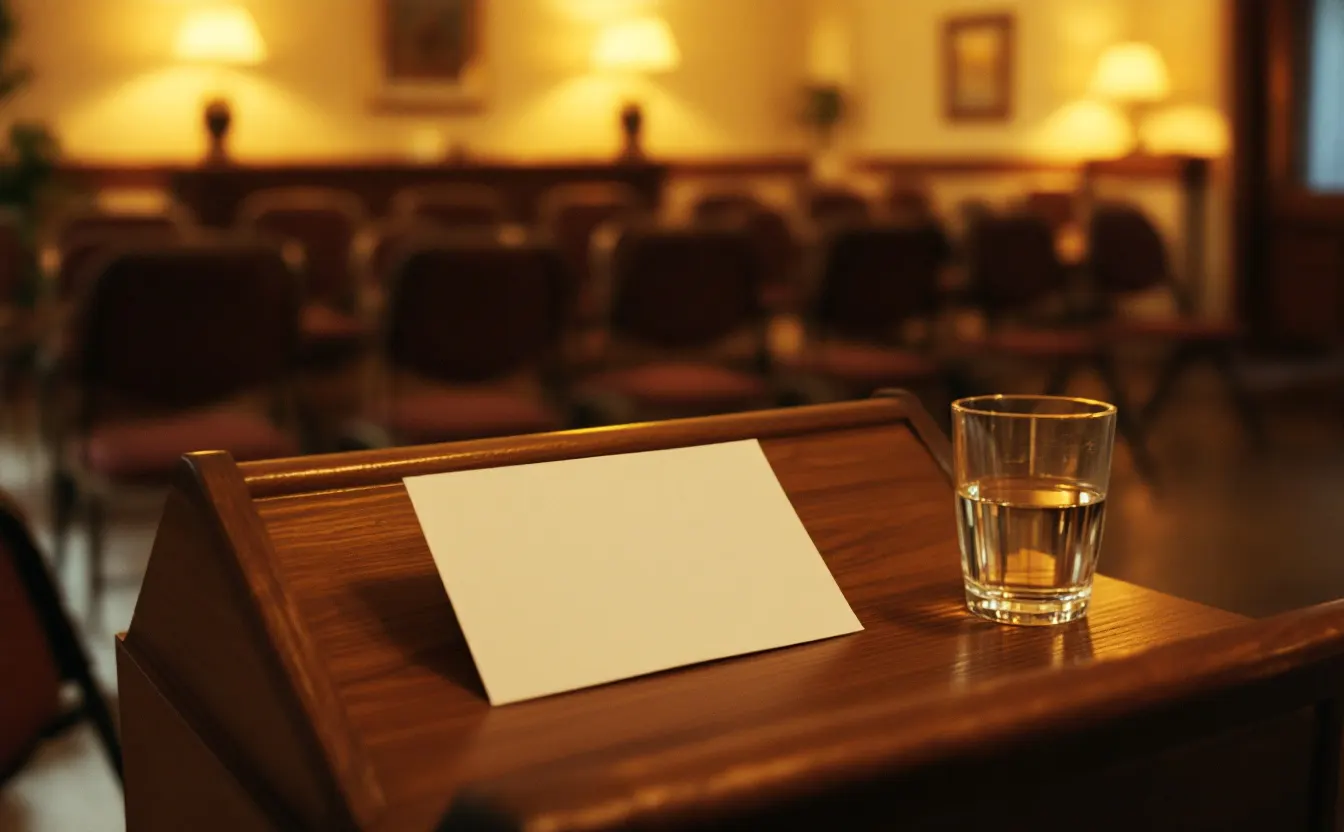
- Give your hands a job. Hold your note card in one hand, or rest both lightly on the lectern. Avoid holding a single sheet of thin paper, which flutters with every tremor. A stiff card stays still.
- Plant your feet. Stand with your weight even on both feet, about hip-width apart. Shifting from foot to foot feeds the jitters and starts to look like pacing.
- Breathe out slowly before you begin. In through the nose, then a long, unhurried breath out, once or twice, while you set your card down. It looks like you are getting organized. You are.
- Start a little lower and slower than feels natural. A nervous voice tends to climb and hurry, so aiming slightly low and slow lands you somewhere normal.
- Keep water within reach. A dry mouth is common, one sip fixes it, and the sip buys you a pause.
From the third row, a trembling card mostly looks like a card.
If your mind goes blank
It happens, sooner or later, to nearly everyone who speaks often enough, and the recovery is simpler than the fear.
First, stop and look down at your card. A pause of three or four seconds feels endless at the front and perfectly normal from a chair. Nobody thinks "she's lost". They think "she's checking her notes", because you are.
Second, if the card does not rescue you, say the last thing you said again, in slightly different words. "So, as I was saying, the Saturday crew is thin." Repeating a line often drags the next one back with it.
Third, if it is truly gone, skip ahead. Go to your next keyword, or straight to your close. The room does not know what you planned to say. It only knows what you said.
What prevents blanks best is notes written in keywords you can read at a glance, held where you can see them. Finding your place in a paragraph takes far longer than finding a single word.
If you are talking too fast
Nearly every nervous speaker speeds up, and you cannot feel it while it happens, so build in brakes ahead of time.
- Mark pauses on your card: a slash, or the word "breathe", after each block.
- Wait after a question. If you ask the room something, count three in your head before you carry on. People need a moment, even for a question you never meant them to answer.
- Pause before and after your main point. Silence frames a sentence the way a mat frames a picture.
- Look up at the end of every sentence. It slows you without trying, because it is hard to look up and race at the same time.
- Ask a friend in the room to give you a small signal, touching an ear, say, if you are rushing.
If you notice mid-talk that you are racing, do not apologize. Stop for one full breath and begin the next sentence slower.
If you do not know where to look
Looking at the floor or the ceiling makes you feel safer and makes the room feel left out. Staring at one person makes them squirm. The middle path is to pick three friendly faces, one on the left, one in the middle and one on the right, toward the back, and talk to each of them in turn for a sentence or two.
Toward the back matters. When you look at the back rows, your chin lifts, your voice carries further, and the people at the front still feel included. If the lights are bright and you cannot see faces, look at the places where faces would be. Nobody can tell the difference.
Microphones, projectors and screens in a hall
Equipment is the part nobody rehearses, and it is behind a good share of the bad moments in community halls and church buildings. A few minutes of checking beforehand removes most of the risk.
Handheld or clip-on
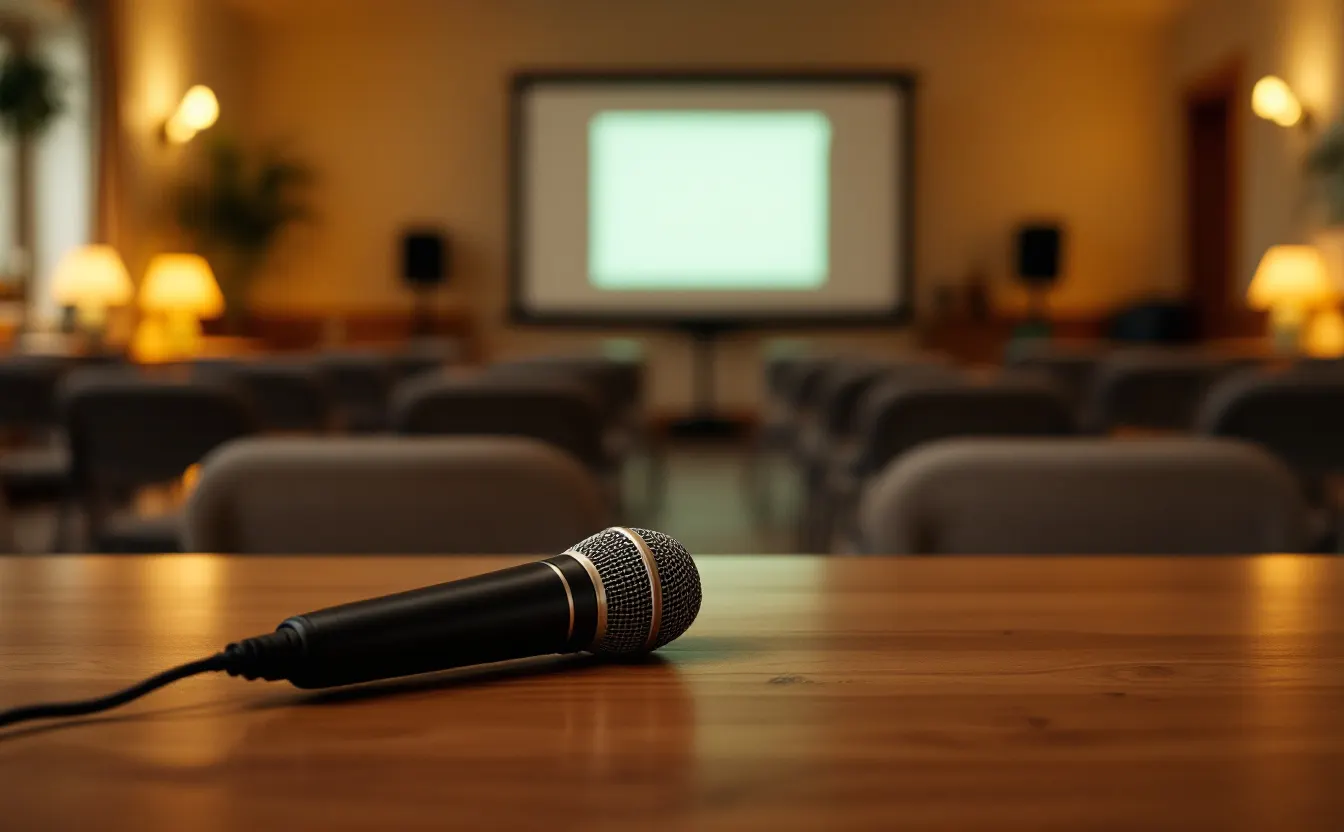
A handheld microphone is the kind you will meet most often, and it is forgiving when several people share it. Hold it below your chin, a few finger-widths from your mouth, pointed at your mouth rather than at your chest. The usual mistake is letting it drift down as you relax, so your voice fades halfway through a sentence. Keep your elbow tucked against your side and the mic tends to stay put.
A clip-on microphone, often called a lavalier, leaves your hands free and suits a longer talk. Clip it to the middle of your chest, on a collar, a button placket or a lapel, roughly a hand's width below your chin. If you will turn toward one side of the room (toward a screen, say), clip it on that side. Run the cable under your top and put the small transmitter pack in a pocket or on a belt, which is easier if you wear something with a waistband. Remember that it is live: it picks up every aside and will carry a muttered comment to the whole room.
Either way, ask who is running the sound and how you will know the mic is on. Do not blow into it or tap it. Just speak: "Testing, one, two. Can the back row hear me?"
Testing the room
Ask for a sound check while the hall is still quiet, ideally fifteen to thirty minutes before people arrive. Say a few sentences at your real speaking volume while someone stands at the back. Your real volume matters. If you murmur during the test and speak up later, the levels will be wrong for the room.
Listen for three things: the back row can hear you clearly, your voice is not booming at the front, and there is no howl or whine.
Where to stand
That howl is feedback, and it happens when a microphone picks up its own sound coming out of a loudspeaker. The fix is mostly about position: stand behind the loudspeakers, or well to one side of them, never in front of them. During your sound check, walk to each spot you plan to use and listen. If one spot squeals, treat it as off-limits.
Notice the light while you are there. If there is a lectern lamp or a spotlight, stand where it falls on your face rather than behind you. And find the edge of any stage or step in good light, so you do not discover it with your heel.
The projector and the screen
If you are using slides, bring them in two forms, the original file and a PDF copy, and keep them in two places, a USB stick and your email. Arrive early enough to connect, because the link between laptop and projector is where most delays happen. Bring your own adapter for your laptop's video port rather than trusting the hall to have the right one.
Once connected, set the display to mirror so you see what the room sees, turn off notifications and plug the laptop into power. Walk to the back and check your smallest text; if you cannot read it from there, it is too small. Then work out where you can stand to see the screen without turning your back on the room and without stepping into the projector's beam. A clicker helps. If there is none, ask a helper to change slides on a nod, and rehearse the nod once before people arrive. The toolkit has a short list of small-venue gear if your hall is missing any of this.
A room check you can copy
Paste this into the notes on your phone and run through it when you arrive.
ROOM CHECK (15 to 30 minutes before)
[ ] Found the person running sound and the order of events
[ ] Know when I am on and how I will be introduced
[ ] Mic tested at full speaking volume, someone at the back
[ ] Know where the loudspeakers are; standing behind or beside
[ ] Know how the mic switches on and off (or who does it)
[ ] Spare batteries or a second mic, and where they are
[ ] Laptop connected, display mirrored, notifications off
[ ] Laptop on power, not battery
[ ] Slides on a USB stick, plus a PDF copy in my email
[ ] Smallest text readable from the back row
[ ] Know where I stand to see the screen without blocking it
[ ] Clicker works, or my helper knows the nod
[ ] Water within reach
[ ] Card in my pocket, first three sentences said out loud once
If something goes wrong in front of everyone
Something will go wrong eventually. The room takes its cue from you, so if you stay calm, they relax.
- The mic cuts out. Lower it and say at full natural volume, "Can you hear me if I speak up?" Carry on without it while someone checks the batteries. A small room often hears an unamplified voice better than you would expect.
- The slides freeze or the screen goes blank. Say "Let's do this the old-fashioned way" and keep going from your card. This is why a talk should stand up without its slides.
- A phone rings, a child shouts, a door bangs. Pause, smile if it fits, let the moment pass, then pick up your last sentence again.
- You make a mistake. Correct it plainly ("Sorry, I meant March, not May") and move on. Apologize once, never twice.
- You run out of time. Skip to your close. Never try to squeeze in the rest at double speed.
For more on presence and storytelling, Talk Like TED by Carmine Gallo has plenty of ideas drawn from polished stage talks. Take what fits a church hall on a weeknight and leave the rest on the shelf.
Your next step is small. Find out who runs the sound in the hall where you will speak, and ask if you can borrow the room for ten minutes before your turn. Stand where you will stand, say your first three sentences into the microphone, and listen to your own voice come back off the far wall. It will sound strange the first time. The second time, it will sound like you.